We're excited to announce that our TrackGBV: Pacific Islands Country Reports are now available on our website. These reports provide key information about gaps in access to justice and can be used by civil society, judiciaries, and the Ministry of Justice to improve legal protections and ensure accountability and consistency in judicial decision-making.
The reports summarize an evidence base of over 20 years of case law that tracks the patterns and impacts of biased decision-making by the courts for cases involving gender-based violence (GBV). They dive deep into the trends displayed on the TrackGBV Dashboard, an interactive tool for stakeholders launched by ICAAD in 2021. The Dashboard is the only comprehensive source of this information in the region and includes data from Fiji, Kiribati, Papua New Guinea, Samoa, Solomon Islands, Tonga and Vanuatu, from 2000-2021.
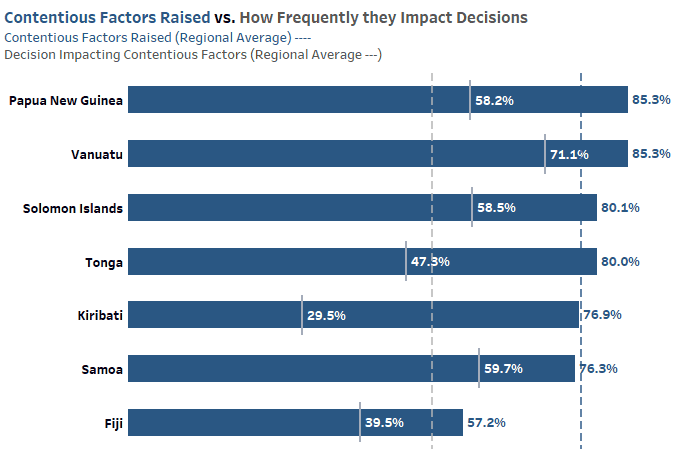
The data shows that nearly 80% of cases involving GBV in Pacific Island Countries raised some form of bias in sentencing decisions, with a quantifiable discriminatory impact on over 50% of cases. These contentious factors, which include gender stereotypes, rape myths, and customary practices, makes clear that access to justice is a major obstacle for victim/survivors of GBV.
“Despite the pervasiveness of GBV, only a small percentage of GBV cases make it to court, and even then, the outcomes are impacted by bias and discrimination. We wanted to understand exactly which factors are contributing to a culture of impunity for perpetrators in order to help our partners advocate more effectively for change,” said Erin Thomas, ICAAD Director and Change Facilitator.
Key Findings from the Regional Report:
- Victims/ survivors who come before the courts are typically between the ages of 6 and 17, pointing to the need for support for children and youth as they access the justice sector.
- In court proceedings, contentious factors (ie. gender stereotypes, customary factors, rape myths, privileging the perpetrator over the survivor) were raised in nearly 80% of cases, with a quantifiable impact on sentencing in over 50%.
- In cases with charges similar to rape, sentences were on average ⅓ shorter when contentious factors were raised.
- The most common procedural barriers to consistency and accountability were: lack of medical reports, misapplication of the first time offender status, and lack of victim anonymity.
Despite progress in some countries on reducing judicial bias and improving access to justice for women and girls, TrackGBV reveals notable gaps for judiciaries across the region. ICAAD has been working closely with civil society organizations, judges, and the legal community to train them on how to use the Dashboard to help address these gaps. This collaboration has already helped inform both legislative and judicial change in the region.
While this data is specific to the Pacific Islands region, it nonetheless offers lessons for access to justice on a global scale – pointing to patterns and trends that may well exist in other countries with similar legal and judicial systems. ICAAD is currently scaling TrackGBV to the Caribbean to continue supporting access to justice and gender equity worldwide.












.png&w=3840&q=75)